

A couple of years ago, if someone told me that I’d be using AI to help me write blog posts, draft emails, or even brainstorm headlines, I probably would’ve laughed. “Sure,” I’d say, “and maybe next week it’ll make my coffee, too.”
Fast forward to today and AI’s basically writing half my content calendar.
But here’s the wild part: this is just the beginning. The future of AI in content creation isn’t just about saving time (although, let’s be real, that’s a huge perk). It’s about transforming how we ideate, create, and connect with audiences at scale.
So if you’re a blogger, small business owner, or content marketer like me, you should definitely pay attention to the shifts happening right now — because they’re changing the game.
AI Isn’t Replacing Writers, It’s Replacing Writer’s Block
Let’s clear this up right away: AI isn’t here to replace real human creativity. It’s here to enhance it.
The best AI tools I’ve used — ChatGPT, Jasper, SurferAI, and others — don’t do the job for you. They give you momentum. When I sit down to write and feel stuck, I prompt the AI for ideas, outlines, or first drafts. It’s like having an assistant who doesn’t sleep, doesn’t judge, and never runs out of suggestions.
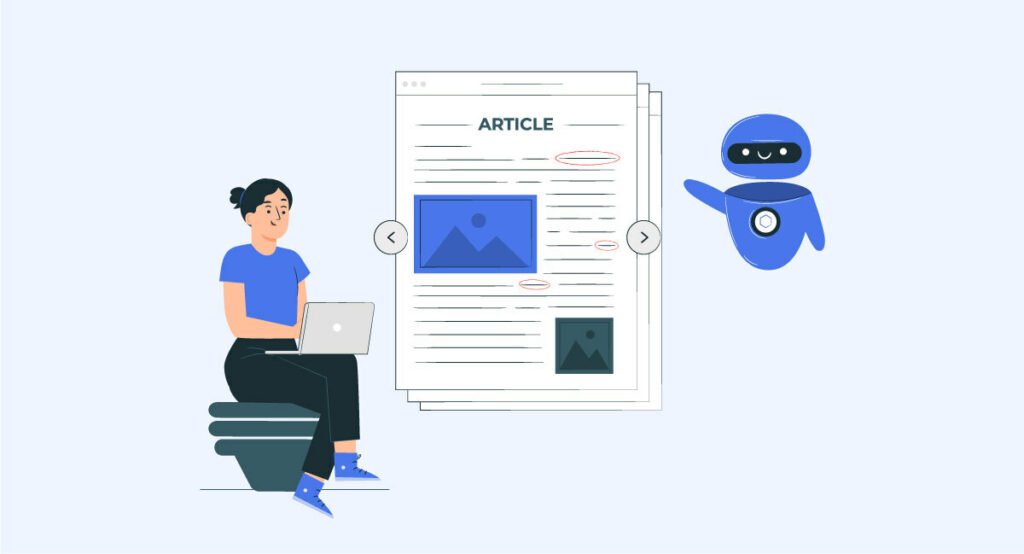
That’s the first big trend: AI as a creative collaborator. The future isn’t about one replacing the other. It’s about human + machine working together.
Trend #1: Hyper-Personalized Content at Scale
One of the biggest headaches for content creators has always been scale vs. relevance. You can write one killer email — but can you write 10 personalized variations without burning out?
Well, AI can.
In the near future, expect AI tools that analyze user behavior, search data, and customer segmentation to generate tailored content for individual users. We’re already seeing it in platforms like Persado and Phrasee, which use AI to write personalized subject lines based on engagement history.
Imagine creating a different version of your newsletter for new leads, loyal customers, and inactive users — all automatically. That’s where we’re headed.
Trend #2: Voice, Style, and Tone Customization
Early AI content felt… robotic. Flat. Generic. But now? Tools are getting really good at mimicking tone — even your tone.
I recently fed a writing sample into an AI tool and trained it to write in my voice. Slight sarcasm, short sentences, a bit of sass. When I compared the AI-written version to mine, I had to double-check who actually wrote it.
Soon, this won’t be a “nice to have” — it’ll be expected. Brands will build custom voice models to maintain consistency across blogs, social media, emails, and ads.
Your voice is your brand. And in the future, your AI assistant will help protect that.
Trend #3: Real-Time Content Optimization
Right now, you write, publish, and then tweak based on performance data. But AI is moving us toward real-time content optimization.
Imagine this: You hit “publish” on a blog post, and your AI monitors how users are engaging. If people bounce too quickly, it adjusts the intro. If a certain section gets skipped, it rewrites it for clarity. All automatically.
Some SEO tools like Clearscope and SurferSEO are already halfway there — suggesting optimizations before you hit publish. The next evolution? Continuous improvement after the content goes live.
This is a game-changer for performance marketers and SEO-driven teams.
Trend #4: Ethical and Originality Concerns Will Get Louder
Let’s not ignore the elephant in the room: AI can also generate junk. Fast.
There’s going to be a growing need for transparency, originality checks, and ethical frameworks around how AI is used. I’ve already seen some sites get hit for publishing “too much” low-value AI content, and Google’s getting smarter about it.
So here’s my take: AI should never be used to fake expertise. Use it to brainstorm. Use it to draft. But always bring your human perspective, experience, and editing skills to the final product.
In the future, the best content will be AI-assisted — but human-approved.
Trend #5: AI Video, Audio, and Visual Content Creation
We’re just scratching the surface with written content. Tools like Synthesia are already creating AI-generated videos from scripts. Descript can clone your voice. Midjourney and DALL·E? They’re designing social graphics, logos, even full illustrations on command.
Soon, a solo creator could produce entire multimedia campaigns — blog post, podcast, video ad, newsletter — in one afternoon, all with AI support.
The question won’t be, “Can I create this?” It’ll be, “What’s the best way to create this — and how fast can I get it out the door?”
Final Thought: The Human Edge Still Wins
I know there’s a lot of buzz (and fear) around AI right now. But here’s the truth: AI is just a tool. The real power still lies in how you use it.
Your experiences, your values, your voice — that’s what connects with people. AI can help you move faster, scale bigger, and get past that blank screen… but your human touch? That’s irreplaceable.
So don’t resist the future. Learn the tools. Test the tech. Stay curious. Because if you combine smart automation with authentic storytelling?